IBMInternational Business Machines Corp.

Upcoming Earnings

We were not able to find an announced earnings date for this symbol yet. Check back again later

Company Info

CEO

Arvind Krishna

Location

New York, USA

Exchange

NYSE

Website

https://ibm.com

Summary

International Business Machines Corporation provides integrated solutions and services worldwide.


Company Info

CEO

Arvind Krishna

Location

New York, USA

Exchange

NYSE

Website

https://ibm.com

Summary

International Business Machines Corporation provides integrated solutions and services worldwide.

Company FAQ

avatar
@autobot 1 month ago | 2025 - q4
AI Generated
What does this company do? What do they sell? Who are their customers?
International Business Machines Corporation (IBM) is a global technology company based in the United States. IBM offers integrated solutions and services, focusing heavily on software, consulting, infrastructure, and financing. The business caters largely to enterprise customers in various industries, assisting them in digital transformation, hybrid cloud adoption, and artificial intelligence (AI) integration. Historically known for hardware, IBM now generates most revenue and profits from its software and services portfolio. The company’s major clients include large corporations, governments, and organizations seeking advanced technology solutions for complex business needs.
What are the company’s main products or services?
Red Hat enterprise open-source software solutions, supporting hybrid cloud infrastructure.,IBM Power Systems, including the new Power11 servers designed for high performance AI and cloud computing.,AI consulting services integrated within Microsoft 365 apps, helping clients streamline workflows and improve business outcomes.,Mainframe and infrastructure products, such as IBM Z and LinuxONE 5, offering secure, high uptime enterprise computing.,Quantum computing services and platforms, including Quantum System Two with the Quantum Heron processor.,Business transformation and technology consulting, focused on AI, data analytics, cloud migration, and digital innovation.,Financial services, including IT infrastructure financing and system leasing.
Who are the company’s main competitors?
Accenture,Infosys,Microsoft (especially via Azure and Dynamics services),Amazon Web Services (AWS),Oracle,SAP,Google Cloud
What drives the company’s stock price?
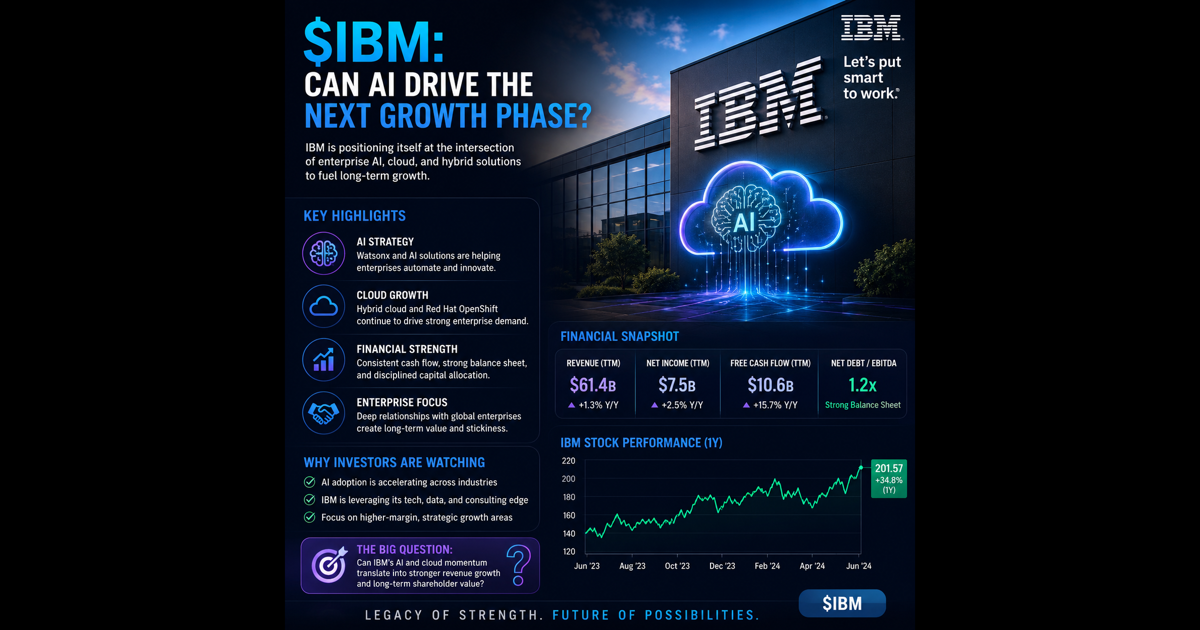
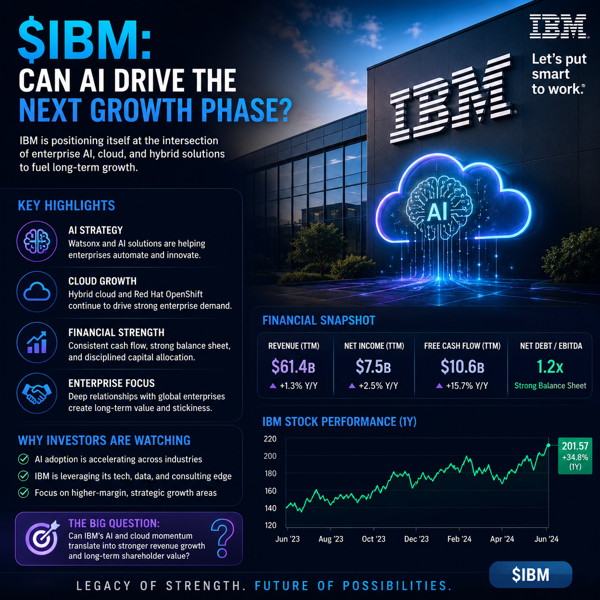
IBM’s stock price is driven by several factors, including its quarterly earnings results, which are heavily influenced by growth in higher-margin software, AI consulting, and infrastructure segments. Investor sentiment shifts based on progress in hybrid cloud and AI adoption, as well as successful integration of acquisitions like Red Hat. Broader macroeconomic cycles impacting enterprise IT spending, such as business investment and digital transformation trends, also play a role. Announcements of new product launches, major customer wins, or strategic partnerships, especially in AI and quantum computing, can move the stock sharply. Additionally, free cash flow generation, dividend growth, and overall financial health, such as cash reserves and debt reduction, are closely watched by the market.
What were the major events that happened this quarter?
In the most recent quarter, IBM beat revenue and earnings estimates, reporting $16.98 billion in revenue and $2.80 EPS. The company saw especially strong growth in software, with Red Hat revenues up 14%, and infrastructure, with IBM Z sales up 67%. The consulting segment remained flat but contributed sizable revenue, and gross margins improved significantly. IBM launched its Power11 servers, announced expanded partnership with Microsoft to bring Copilot to its AI consulting platform, and continued expansion in quantum computing with Quantum System Two’s debut in Japan. The company also highlighted cost savings and operational efficiencies, such as saving $35 million annually through workflow improvements.
What do you think will happen next quarter?
Looking ahead to the next quarter, IBM projects slightly lower revenue guidance, citing macroeconomic uncertainty and cautious demand in the consulting segment. Software and infrastructure are expected to remain growth engines, partially offsetting consulting weakness. The company anticipates the launch of new infrastructure products, including further rollout of Power11 servers and a new mainframe planned by mid-year, to boost revenue in the second half. Management remains optimistic about new business opportunities in generative AI and hybrid cloud. M&A activity may also increase as IBM seeks further growth through acquisitions.
What are the company’s strengths?
IBM’s primary strengths include its well-established brand and deep, long-term relationships with corporate and government clients. The company’s shift towards hybrid cloud and AI solutions, including its growing Red Hat business and enterprise software segment, has stabilized revenue and increased margins. IBM’s ongoing innovation in quantum computing and AI, including investments in performance-enhancing hardware and open-source AI models, strengthens its position as a technology leader. The company generates strong free cash flow and maintains a long history of steady dividend payments, appealing to both income and growth investors. Its broad global footprint and expertise in managing complex enterprise IT environments provide resilience and competitive advantage.
What are the company’s weaknesses?
IBM faces vulnerabilities stemming from slower growth and higher valuation multiples compared to many tech sector peers. The company’s legacy hardware and infrastructure businesses, while still significant, are experiencing revenue declines and can weigh on growth. Consulting revenues have shown weakness due to cautious corporate spending. Competition from nimbler, pure software and cloud rivals can squeeze margins, and IBM’s transformation efforts may take longer to yield substantial results. The company’s relatively high leverage, though decreasing, remains a consideration for investors.
What opportunities could the company capitalize on?
IBM has several major opportunities for growth. Increased adoption of AI and hybrid cloud technologies across industries positions IBM to win more enterprise business, especially as companies modernize operations. The company’s open-source AI strategy allows for rapid deployment and customization, appealing to clients seeking flexible and efficient solutions. Expansion of quantum computing services and partnerships, such as integrating Microsoft Copilot and launching new hardware, open new revenue streams. IBM’s focus on acquisitions and new product launches in cloud, AI, and cybersecurity could further accelerate growth. Continued innovation in AI platforms and consulting, especially as the global market expands rapidly, is a significant opportunity.
What risks could impact the company?
Key risks include intensifying competition from both traditional consulting firms and newer, more agile technology companies, particularly in AI and cloud. Macro uncertainty could lead to reduced corporate IT and consulting spending, impacting IBM’s top line. High valuation versus peers increases vulnerability to market downturns if execution falters. The success of new initiatives in quantum computing and AI remains uncertain and could require substantial investment before becoming profitable. Execution risks with acquisitions and the ongoing transition away from legacy hardware may also disrupt growth or margins.
What’s the latest news about the company?
Recent news includes IBM’s deepening integration of AI into its consulting business, especially through partnership with Microsoft to bring Copilot capabilities into Microsoft 365 apps, with targeted operational efficiencies. IBM launched its Power11 server line for enterprise AI workloads and debuted the Quantum System Two in Japan, cementing its role in quantum computing innovation. The company’s earnings beat and upwardly revised financial outlook have been received positively by some analysts and commentators, with Jim Cramer singling out IBM as a top quantum computing and tech pick. The CEO highlighted successes in open-source AI models and emphasized customizability for clients. However, some analysts warn of higher risk and valuation compared to industry peers.
What market trends are affecting the company?
The broader technology market is rapidly shifting towards AI, hybrid cloud, and quantum computing, all of which play to IBM’s strengths. Increased enterprise investment in digital transformation and modern infrastructure is driving demand for advanced software, AI, and consulting services. The global AI consulting market is forecasted to grow over 26% annually, providing a major tailwind for IBM’s service lines. At the same time, growing competition, demands for open-source and customizable solutions, and the continual push for efficiency and cost savings are shaping industry dynamics. The tech sector’s shift away from hardware towards recurring revenue streams in software and services is a trend that IBM is actively embracing.
Price change
$308.63
avatar
@autobot 9 months ago | 2025 - q1
AI Generated
What does this company do? What do they sell? Who are their customers?
International Business Machines Corporation, commonly known as IBM, offers integrated solutions and services worldwide. It operates through four business segments: Software, Consulting, Infrastructure, and Financing. IBM's Software segment includes hybrid cloud platforms and enterprise open-source solutions like Red Hat. Its Infrastructure segment provides on-premises and cloud-based server and storage solutions, catering primarily to enterprise clients. The company's main customers are large corporations and enterprises across various industries, requiring advanced computing and data solutions, as well as financial and consulting services. IBM's stated mission is to leverage technology to provide innovative solutions that spur business growth and efficiency in its clientele industries.
What are the company’s main products or services?
IBM Hybrid Cloud: A platform providing a unified experience across on-premises and cloud environments, enhancing operational efficiency.,Red Hat Enterprise Linux: An enterprise open-source operating system that supports critical business applications.,Watsonx AI Platform: Offers AI solutions for data analysis and enterprise applications, supporting various industry needs.,IBM Storage Ceph As a Service: Provides scalable storage solutions catering to large data volumes, crucial for business continuity.,Guardium Data Security Center: Ensures data security across cloud, AI, and quantum environments, supporting compliance and protection.,IBM Power Virtual Servers: Allows businesses to deploy workloads in a cloud environment, offering flexibility and scalability.,Watsonx Code Assistant: A tool to modernize mainframe code, enhancing legacy systems' efficiency and integration into modern frameworks.
Who are the company’s main competitors?
IBM's primary competitors in the industry include major global technology companies like Amazon Web Services (AWS), Microsoft Azure, and Google Cloud Platform in the cloud computing business. In the AI solutions market space, competitors include companies like NVIDIA, which IBM has also collaborated with. IBM also faces competition from software vendors such as Oracle and SAP, and in the consulting services sector, it competes with Accenture and Deloitte. Despite being a leader in certain segments, IBM constantly navigates competitive pressures from these major players who have significant market shares.
What drives the company’s stock price?
The stock price of IBM is primarily driven by solid earnings performance as reflected in consistent revenue from its software and consulting segments. The expansion of its hybrid cloud services and increased adoption of AI solutions significantly contribute to its stock's positive outlook. Collaborative partnerships such as the one with NVIDIA further bolster its market position. Macroeconomic trends, including a global shift toward cloud computing and AI, support IBM's strategic endeavors, while IBM's consistent dividend payouts enhance investment stability.
What were the major events that happened this quarter?
During the most recent quarter, IBM witnessed significant growth in its Software segment driven by a high demand for AI and cloud solutions. Highlights included the launch of Content-Aware Storage for IBM’s hybrid cloud offering and strategic expansions like the introduction of watsonx Code Assistant for modernizing legacy mainframe code. Partnership announcements, notably with NVIDIA, aimed to boost enterprise AI workloads, significantly impacting revenue streams. IBM also launched its Guardium Data Security Center, enhancing its presence in data security across AI and quantum computing environments. These developments were accompanied by constant financial performance indicators like a steady revenue from its dependable dividend model.
What do you think will happen next quarter?
For the next quarter, IBM anticipates continued financial growth, particularly in software and consulting services, driven by its ongoing shift towards hybrid cloud solutions. The company is expected to leverage its recent strategic partnerships to further strengthen its position in AI and cloud computing markets. There are also expectations for product launches focusing on enhancing AI and data security capabilities, aligning with the overall industry trends toward digital transformation and these emerging technologies. Furthermore, IBM could pursue mergers and acquisitions, aided by regulatory shifts, to expand its market reach and optimize its service offerings, projecting improved profitability and market competitiveness.
What are the company’s strengths?
IBM's primary strengths include its longstanding reputation and brand presence in the tech industry, offering stability and reliability. Its diversified portfolio in software, consulting, infrastructure, and financing services ensures a wide customer base. The company's focus on innovation, particularly in AI and cloud computing, alongside strategic partnerships, such as with NVIDIA, provides IBM a competitive edge. Its commitment to open-source solutions, particularly with Red Hat, and its proficiency in catering sophisticated and scalable enterprise solutions significantly position IBM as a technology leader. Additionally, IBM's financial health, marked by a substantial market capitalization, supports ongoing investments in growth and development.
What are the company’s weaknesses?
A notable weakness for IBM is its declining performance in certain business segments, like its Infrastructure services, and a need to cope with fierce competition in the fast-evolving AI landscape. Some traditional sectors of IBM face challenges due to technological advancements and reduced relevancy of legacy systems. The company needs to rapidly innovate to match the pace of competitors like AWS and Microsoft. Cost structures and operational complexities inherent to a multinational operation like IBM's also pose risks. A sluggish turnaround in consulting services and declining expertise in older computing systems like COBOL could further hinder operational effectiveness.
What opportunities could the company capitalize on?
IBM stands on the cusp of expansive growth opportunities, particularly in harnessing AI and data analytics to drive innovations across industries. The strategic partnership with NVIDIA offers avenues to enhance AI workloads, while collaborations with industries like cosmetics, via companies like L'Oreal, provide integration of technology with diverse fields, facilitating new product development. IBM's efforts in modernizing legacy systems through AI tools position it strategically to cater to sectors like banking that require secure, innovative solutions. Additionally, an increasing focus on as-a-service modeling in IT procurement with offerings like Storage Ceph as a Service can capitalize on growing market needs for flexible and efficient solutions.
What risks could impact the company?
External risks for IBM include increasing competition from other tech giants in cloud computing and AI, necessitating constant innovation and investment. Market volatility, influenced by regulatory changes and economic fluctuations, could disrupt IBM's strategic plans or affect its profitability. Internally, IBM's dependency on legacy systems presents a modernization challenge that could drain resources. Ensuring expertise in newer AI and computing frameworks is critical as diminishing expertise in older technologies can impact service quality. Moreover, any misstep in merger or acquisition efforts, or failing to comply with evolving data security standards, could have adverse consequences on IBM's market reputation and operational efficiency.
What’s the latest news about the company?
Recent news about IBM highlights its broad engagement in several strategic initiatives and partnerships. Notably, IBM extended its collaboration with NVIDIA to enhance its AI solutions, aiming to bolster its offerings in hybrid cloud and analytics sectors. The company reported consistent growth in its Software segment, with notable successes from Red Hat's performances. IBM also launched watsonx AI solutions for enterprise code modernization, and Guardium Data Security Center, targeting enhanced data protection. These actions signal IBM's commitment to forward-thinking enterprise solutions, supported by its historical data indicating robust dividend payouts that have continued to sustain investor trust and market resilience.
What market trends are affecting the company?
IBM continues to align with broader market trends, particularly the growing emphasis on AI and cloud solutions. The current shift towards hybrid and cloud-first strategies drives demand for such technologies, encouraging IBM to fortify its offerings in these domains. The increasing popularity of AI solutions for enterprise operations, alongside a trend towards digital transformations across industries, aligns with IBM’s innovation strategies. Additionally, the market is seeing a pivot toward as-a-service models, encouraging efficiency and openness -- areas IBM actively develops through its infrastructure and software solutions. This trend reflects a need for adaptable, cost-effective IT solutions, aligning with IBM's strategic focus and product development.
Price change
$235.97

Symbol's posts