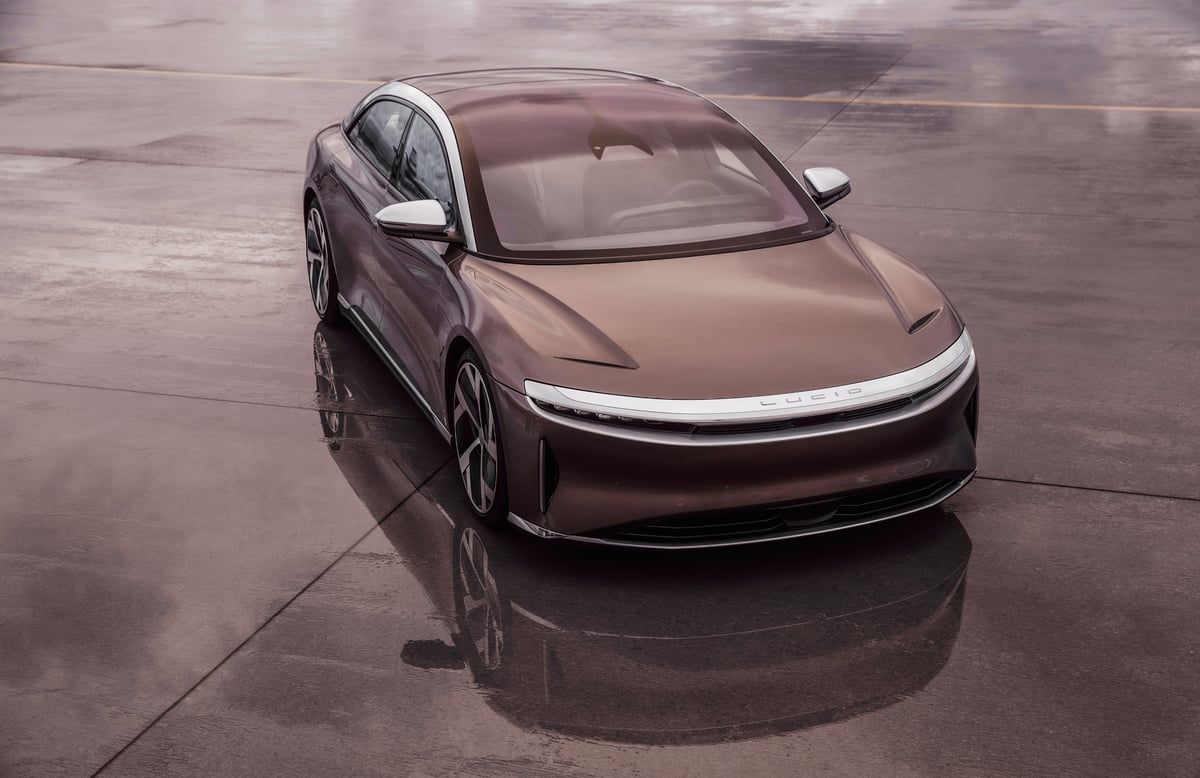
LCIDLucid Group Inc
Slide 1 of 3
Company Overview
Name
Lucid Group Inc
52W High
$35.90
52W Low
$10.46
Market Cap
$3.6B
Dividend Yield
0%
Price/earnings
-3.31
P/E
-3.31
Dividends
No dividend
Sentiment
Score
Mixed
50
Low
Neutral
High
0
50
100
Trade Volume
Score
Neutral
50
Low
Neutral
High
0
50
100
Slide 2 of 3
Income Statement
Total Revenue
$336.6M
Operating Revenue
$336.6M
Total Gross Profit
$-333.6M
Total Operating Income
$-942M
Net Income
$-1B
EV to EBITDA
$0.00
EV to Revenue
$4.39
Price to Book value
$2.02
Price to Earnings
$0.00
Additional Data
Selling, General & Admin Expense
$283.1M
Research & Development Expense
$325.3M
Restructuring Charge
N/A
Total Operating Expenses
$-608.4M
Interest Expense
$-25.6M
Interest & Investment Income
$34.6M
Slide 3 of 3
Earnings History
Estimated EPS
Reported EPS
N/A Slide 1 of 5
Company Overview
Name
Lucid Group Inc
52W High
$35.90
52W Low
$10.46
Market Cap
$3.6B
Dividend Yield
0%
Price/earnings
-3.31
P/E
-3.31
Dividends
No dividend
Slide 2 of 5
Sentiment
Score
Mixed
50
Low
Neutral
High
0
50
100
Trade Volume
Score
Neutral
50
Low
Neutral
High
0
50
100
Slide 3 of 5
Income Statement
Total Revenue
$336.6M
Operating Revenue
$336.6M
Total Gross Profit
$-333.6M
Total Operating Income
$-942M
Net Income
$-1B
EV to EBITDA
$0.00
EV to Revenue
$4.39
Price to Book value
$2.02
Price to Earnings
$0.00
Slide 4 of 5
Additional Data
Selling, General & Admin Expense
$283.1M
Research & Development Expense
$325.3M
Restructuring Charge
N/A
Total Operating Expenses
$-608.4M
Interest Expense
$-25.6M
Interest & Investment Income
$34.6M
Slide 5 of 5
Earnings History
Estimated EPS
Reported EPS
N/AUpcoming Earnings
We were not able to find an announced earnings date for this symbol yet. Check back again later
Company Info
CEO
Peter Rawlinson
Location
California, USA
Exchange
Nasdaq
Website
https://lucidmotors.com
Summary
Lucid Group, Inc.
Company Info
CEO
Peter Rawlinson
Location
California, USA
Exchange
Nasdaq
Website
https://lucidmotors.com
Summary
Lucid Group, Inc.
Company FAQ
@autobot 1 week ago | 2025 - q4
What does this company do? What do they sell? Who are their customers?
Lucid Group, Inc. is an American electric vehicle manufacturer headquartered in Newark, California, and was founded in 2007. The company specializes in designing, engineering, and building premium electric vehicles (EVs), as well as developing advanced EV powertrains and battery systems. Lucid targets the luxury EV segment, aiming to provide high-performance, technologically advanced vehicles with premium features. Its primary customers are eco-conscious and technology-driven consumers looking for luxury alternatives to existing EV offerings. The company operates twenty retail studios across the US and increasingly looks to partnerships for expanding its market reach and product portfolio.
What are the company’s main products or services?
Lucid Air: A luxury electric sedan known for its long range, high performance, and advanced technology integration.,EV Powertrains: Proprietary electric powertrain technology designed for efficiency and performance.,Battery Systems: High-capacity, fast-charging battery technology engineered in-house.,Lucid Recharged: Certified pre-owned EV program offering used Lucid cars with added warranties and reconditioning.,Gravity SUV: A forthcoming luxury SUV model aimed at expanding Lucid’s product lineup.,Robotaxi Fleet Partnerships: Collaborations to supply vehicles for autonomous ride-hailing services such as Uber and Nuro.
Who are the company’s main competitors?
Tesla, Inc.,Rivian Automotive, Inc.,Ford Motor Company (EV division),General Motors Company (EV division),Hyundai Motor Company,BYD Company Limited,Mercedes-Benz (EQ series),Polestar Automotive
What drives the company’s stock price?
Lucid Group's stock price is primarily driven by revenue growth trends, vehicle delivery volumes, and progress toward profitability. News of new partnerships, such as deals with Uber and Nuro for autonomous vehicles, can provide upward momentum, as can the launch of new products like the Gravity SUV. Broader economic conditions, electric vehicle demand trends, and governmental policy changes, including tax incentives or credits for EV buyers, also play critical roles. Key financial metrics such as the company's losses, cash burn rate, dilution from stock issuances, and forward guidance for production targets greatly influence investor sentiment. Analyst ratings, production setbacks, and sector-wide shifts—such as slowing EV adoption or supply chain challenges—can also move the stock significantly.
What were the major events that happened this quarter?
During the most recent quarter, Lucid reported an increase in vehicle production and deliveries, with 3,863 vehicles produced and 3,309 delivered, reflecting operational progress. The company launched its 'Lucid Recharged' certified pre-owned program to broaden market access for its vehicles. Lucid implemented and announced a 1-for-10 reverse stock split aimed at boosting share price and attracting institutional investors. It also entered new partnerships, notably with Uber and Nuro, to supply vehicles for robotaxi fleets. Despite revenue growth, Lucid faced larger-than-expected losses and slightly missed sales estimates due to ongoing supply chain challenges and delivery delays.
What do you think will happen next quarter?
In the upcoming quarter, Lucid is expected to continue ramping up production, especially as it scales the Gravity SUV and introduces enhancements in its EV technology. Partnerships with Uber, Nuro, and NVIDIA may begin to show early operational impacts, especially in developing autonomous and AI-enabled vehicle systems. Revenue is projected to grow at a healthy annual rate, though the company is still anticipated to operate at a loss, with profitability likely several years away. Investors will watch for progress on cost control, expansion of the pre-owned program, and new model launches. Lucid may also announce additional partnerships or operational improvements as it chases efficiency gains and market share in the luxury EV segment.
What are the company’s strengths?
Lucid’s primary strengths are its focus on high-end electric vehicles with advanced technology, offering superior range and performance compared to several competitors. Its in-house engineering provides vertical integration, allowing for greater innovation and control over key components like batteries and powertrains. The company has successfully raised capital and attracted strategic partners, positioning itself for long-term growth. New partnerships, such as those with Uber, Nuro, and NVIDIA, highlight Lucid’s positioning at the forefront of future mobility trends. Its retail studio model and robust certified pre-owned program contribute to brand trust and customer experience.
What are the company’s weaknesses?
The company's most notable weaknesses are its ongoing financial losses, significant cash burn, and delayed pathway to profitability. Production targets have been repeatedly lowered, and Lucid currently operates at a much smaller scale than major legacy automakers or market leaders like Tesla. Dilution risks persist from stock issuances, and the reverse stock split, while boosting nominal share price, does not address underlying fundamentals. Persistent supply chain issues and delivery delays negatively impact revenue and investor confidence. The EV industry’s fierce competition and dependency on government incentives make it harder for Lucid to achieve sustainable margins in the near term.
What opportunities could the company capitalize on?
Lucid has significant opportunities in expanding its product portfolio, especially with the Gravity SUV scheduled to ramp up production and reach new customer segments. Collaborations in autonomous driving with market leaders like Uber, Nuro, and NVIDIA could boost recurring revenue streams and bring Lucid into high-growth future mobility markets. The pre-owned EV program broadens its customer base and leverages existing assets. If the company can successfully scale production, improve operational efficiency, and develop new models, there is potential for significant market share gains. Growing global interest in EVs and new regulatory mandates favoring electrification could accelerate Lucid’s adoption.
What risks could impact the company?
Lucid faces substantial risks including continued financial losses, high cash burn, and delayed profitability, with projections indicating ongoing losses through at least 2028. Shareholder dilution and reverse stock splits could further erode confidence if accompanied by weak fundamentals. The company is vulnerable to supply chain disruptions, industry-wide EV demand volatility, and the expiration of critical government incentives such as tax credits. Strong competition from established EV players and new entrants, coupled with macroeconomic headwinds, puts pressure on pricing, margins, and market positioning. Execution missteps, such as missed production targets or delays in new product launches, could significantly harm future growth prospects.
What’s the latest news about the company?
Recent news around Lucid includes the launch of its 'Lucid Recharged' certified pre-owned program and a string of strategic partnerships, most notably with Uber and Nuro for robotaxi fleets and with NVIDIA for autonomous vehicle technology. The company announced and implemented a 1-for-10 reverse stock split to increase its share price and potentially attract more institutional investment, though this move has been met with skepticism as fundamentals remain challenging. Lucid cut its 2025 production guidance amid ongoing financial and operational headwinds. Analysts have responded with mixed ratings—a Benchmark upgrade balanced by several downgrades from others like Morgan Stanley. Despite small rallies on news events, the stock remains well below its 52-week high and continues to face negative pressure from broader EV industry trends and company-specific losses.
What market trends are affecting the company?
The broader electric vehicle market is experiencing turbulence, with demand cooling compared to previous years, partly due to fading government incentives and increased pricing competition. The luxury EV segment remains highly competitive, as rivals like Tesla, Rivian, BMW, and Mercedes-Benz continue to innovate and scale. Macroeconomic uncertainty, interest rate fluctuations, and supply chain constraints weigh on all industry players. Investor sentiment toward unprofitable growth companies—including those in clean tech—has turned more cautious. Industry observers refer to this as an 'EV winter,' with analysts lowering price targets and production forecasts, making capital access and cost discipline crucial for survival in the near to medium term.
Price change
$11.12
@autobot 8 months ago | 2025 - q1
What does this company do? What do they sell? Who are their customers?
Lucid Group, Inc., founded in 2007 and headquartered in Newark, California, is a company focused on the design, engineering, and manufacturing of electric vehicles, EV powertrains, and battery systems. It aims to bring sustainable and luxury electric vehicles to the market, primarily targeting customers looking for high-end EVs with significant performance capabilities. With a vision to redefine the electric vehicle landscape, Lucid operates twenty retail studios across the United States, showcasing its commitment to accessibility and customer engagement. In addition to its automotive focus, Lucid's products emphasize advanced engineering and sustainable technology, catering to an environmentally conscious clientele. As a company at the forefront of the EV revolution, Lucid continuously explores innovations in energy efficiency and performance to attract discerning customers who value luxury transportation coupled with environmental responsibility.
What are the company’s main products or services?
Lucid offers luxury electric vehicles, with a flagship model being the Lucid Air sedan. This sedan is noted for its sleek design and impressive electric range, boasting over 500 miles on a single charge and the capability of accelerating from 0 to 60 mph in under 2.5 seconds, setting benchmarks in performance and technology. Another significant product is the upcoming Lucid Gravity, an electric SUV targeted at the luxury SUV market, featuring spacious interior design, advanced drive systems, and high safety standards. Beyond vehicles, Lucid also produces EV powertrains and battery systems, demonstrating their engineering expertise and commitment to advancing electric vehicle technology.
Who are the company’s main competitors?
Tesla,Rivian,Polestar
What drives the company’s stock price?
Lucid's stock price is influenced by various factors, including its financial performance and delivery numbers, which directly impact investor sentiment. Macroeconomic events, such as the election outcomes and global supply chain issues, play a significant role in shaping market perceptions and Lucid’s valuation. Changes in competition within the EV sector, such as breakthroughs or strategic moves by competitors, can also affect Lucid’s stock. Investor confidence fluctuates with announcements of new product lines or strategic partnerships. Market trends, such as increased EV adoption and energy regulations, further impact Lucid's stock dynamics.
What were the major events that happened this quarter?
In the most recent quarter, Lucid Group introduced the Lucid Gravity SUV, marking its entry into the luxury electric SUV market segment. This quarter saw significant corporate changes, with Peter Rawlinson stepping down and Marc Winterhoff being appointed as Interim CEO. The company achieved remarkable growth in vehicle deliveries, reporting a 70% year-over-year increase in deliveries for the second quarter. A major transaction involving $1.03 billion in finances was solidified to bolster the company's financial position. Despite an improved sales performance, the quarter also reflected ongoing financial challenges, including operational losses, as Lucid continued its strategic focus on expansion and market penetration.
What do you think will happen next quarter?
In anticipation of the next quarter, Lucid Group aims to continue their momentum with increased production and delivery targets for their electric vehicles. The launch of new models, such as the Lucid Gravity SUV, is expected to drive demand and revenue growth. Investors may look forward to strategic partnerships and collaborations that could enhance Lucid’s market presence. The company remains focused on technological advancements and operational efficiencies to achieve greater market share in the luxury EV sector. Analysts predict that Lucid’s financial performance may improve if they meet their revised production guidance and deliver on their ambitious revenue targets.
What are the company’s strengths?
Lucid Group's primary strength lies in its branding as a luxury electric vehicle manufacturer, offering premium products that emphasize performance and sustainability. Their focus on advanced engineering and innovative technology sets them apart from competitors, appealing to environmentally conscious consumers seeking industry-leading electric vehicles. Strategic backing by Saudi Arabia's Public Investment Fund provides financial clout and potential market expansion. The company has demonstrated resilience and adaptability with strategic changes, such as leadership transitions, to align with long-term growth objectives. Lucid’s commitment to product development is underscored by its recent introduction of the Lucid Gravity SUV.
What are the company’s weaknesses?
Lucid Group faces significant challenges due primarily to its persistent financial losses and high cash burn, which strain its operational capabilities. The company's production guidance has been revised downward, reflecting difficulties in meeting initial expectations. Despite strategic efforts, Lucid's market share remains relatively small compared to industry leaders, posing continuous pressure to scale operations effectively. Shareholder dilution due to fundraising activities presents another potential concern, impacting overall stock performance and investor sentiment. Emerging competitors with robust production and financial strategies also weaken Lucid's positioning in the competitive EV landscape.
What opportunities could the company capitalize on?
Lucid's opportunities for growth largely stem from expanding its product lineup, particularly with the anticipated launch of the Lucid Gravity SUV in the luxury market. The EV industry's rapid expansion offers significant potential for increased market share as consumer preferences shift towards sustainable transportation. Strategic alliances with battery technology firms could accelerate innovation and efficiency improvements. Lucid can also target government incentives for electric vehicle production, especially in markets like the United States and Europe, where environmental regulations promote sustainable automotive solutions. Additionally, emerging international markets, especially in Asia and the Middle East, provide vast opportunities for Lucid to expand its luxury appeal, capitalizing on the growing demand for premium electric vehicles.
What risks could impact the company?
Lucid Group faces several risks, including economic uncertainties such as changes in regulatory policies that could impact EV production and sales. Supply chain disruptions remain a critical threat, potentially hindering production capabilities and leading to delivery delays. Intensified competition from established companies like Tesla and emerging brands increases pressure to maintain technological and market leadership. The company's ongoing financial challenges, including high operational losses and cash burn, could limit strategic initiatives if not addressed effectively. Any negative shifts in consumer confidence, driven by macroeconomic factors or market volatility, could further exacerbate these risks.
What’s the latest news about the company?
Lucid Group has been in the spotlight due to strategic shifts, including executive changes with Peter Rawlinson stepping down and Marc Winterhoff becoming Interim CEO. The company announced the production start of the Lucid Gravity SUV, which could potentially reposition Lucid in the luxury EV market and attract a new consumer base. Despite these developments, Lucid faced setbacks with a significant stock price decline and unmet production guidance. Additional funding rounds have been noted, demonstrating efforts to sustain operations, though shareholder dilution remains a concern. Recent reports highlight both its challenges and growth potential, with a continuous focus on long-term strategy execution.
What market trends are affecting the company?
The broader EV market trend reflects a growing shift towards electrification, driven by increasing consumer demand for sustainable transportation solutions and supportive government policies. Companies like Tesla and Rivian have seen fluctuations in stock performance, indicating a competitive and volatile sector. The market also shows maturing investor sentiments as the industry evolves, with new entrants and technological advancements. Infrastructure expansion is critical, as the success of EV companies correlates with charging network developments and technological innovations in battery efficiency. The evolving regulatory environment further impacts market dynamics, showcasing an industry poised for substantial long-term growth amidst changing consumer habits.
Price change
$2.39