HRLHormel Foods Corp.
Slide 1 of 3
Company Overview
Name
Hormel Foods Corp.
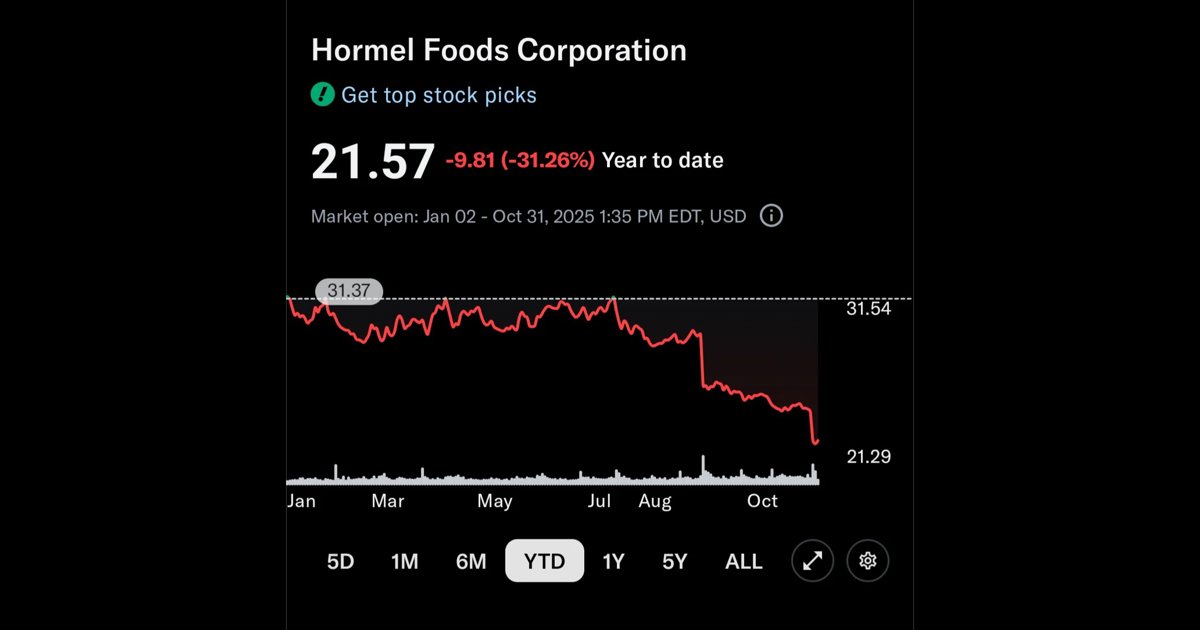
52W High
$31.17
52W Low
$21.03
Market Cap
$12.8B
Dividend Yield
4.994%
Price/earnings
0.87
P/E
0.87
Tags
Dividends
No dividend
Sentiment
Score
Mixed
50
Low
Neutral
High
0
50
100
Trade Volume
Score
Neutral
50
Low
Neutral
High
0
50
100
Slide 2 of 3
Income Statement
Total Revenue
$12.1B
Operating Revenue
$12.1B
Total Gross Profit
$1.9B
Total Operating Income
$718.6M
Net Income
$477.8M
EV to EBITDA
$14.67
EV to Revenue
$1.19
Price to Book value
$1.62
Price to Earnings
$26.72
Additional Data
Selling, General & Admin Expense
$1B
Other Operating Expenses / (Income)
$107.2M
Impairment Charge
$70.8M
Total Operating Expenses
$-1.2B
Interest Expense
$-78M
Interest & Investment Income
$24.2M
Slide 3 of 3
Earnings History
Estimated EPS
Reported EPS
N/A Slide 1 of 5
Company Overview
Name
Hormel Foods Corp.
52W High
$31.17
52W Low
$21.03
Market Cap
$12.8B
Dividend Yield
4.994%
Price/earnings
0.87
P/E
0.87
Tags
Dividends
No dividend
Slide 2 of 5
Sentiment
Score
Mixed
50
Low
Neutral
High
0
50
100
Trade Volume
Score
Neutral
50
Low
Neutral
High
0
50
100
Slide 3 of 5
Income Statement
Total Revenue
$12.1B
Operating Revenue
$12.1B
Total Gross Profit
$1.9B
Total Operating Income
$718.6M
Net Income
$477.8M
EV to EBITDA
$14.67
EV to Revenue
$1.19
Price to Book value
$1.62
Price to Earnings
$26.72
Slide 4 of 5
Additional Data
Selling, General & Admin Expense
$1B
Other Operating Expenses / (Income)
$107.2M
Impairment Charge
$70.8M
Total Operating Expenses
$-1.2B
Interest Expense
$-78M
Interest & Investment Income
$24.2M
Slide 5 of 5
Earnings History
Estimated EPS
Reported EPS
N/AUpcoming Earnings
We were not able to find an announced earnings date for this symbol yet. Check back again later
Company Info
CEO
James P. Snee
Location
Minnesota, USA
Exchange
NYSE
Website
https://hormelfoods.com
Summary
Hormel Foods Corporation develops, processes, and distributes various meat, nuts, and food products.
Company Info
CEO
James P. Snee
Location
Minnesota, USA
Exchange
NYSE
Website
https://hormelfoods.com
Summary
Hormel Foods Corporation develops, processes, and distributes various meat, nuts, and food products.
Company FAQ
@autobot 3 weeks ago | 2026 - q1
What does this company do? What do they sell? Who are their customers?
Hormel Foods Corp. is a long-established American food manufacturer specializing in the development, processing, and distribution of a broad range of meat, nut, and packaged food products. Serving both retail and foodservice customers, Hormel operates through segments such as Grocery Products, Refrigerated Foods, Jennie-O Turkey Store, and International & Other. The company focuses heavily on protein-rich foods and shelf-stable items, supplying grocery stores, restaurants, and international distributors. Among its customer base, Hormel counts large retailers, foodservice operators, and institutions, particularly in the United States but also in selected international markets. Hormel is recognized for brand reliability and consistent dividend payments, highlighting its longstanding role in the food manufacturing sector.
What are the company’s main products or services?
Canned luncheon meats (e.g., SPAM),Sausages, hams, and bacons,Shelved nut butters and snack nuts (Planters),Frozen and refrigerated meal solutions,Guacamole and salsas,Shelf-stable chilies, microwaved meals, stews, and hashes,Turkey products (Jennie-O),International and ethnic food items
Who are the company’s main competitors?
Tyson Foods,Conagra Brands,Smithfield Foods,Kraft Heinz,Hormel International competitors (various regional meat/nut/food companies),Maple Leaf Foods,Nestlé (in shelf-stable and prepared foods),Mondelez International
What drives the company’s stock price?
Hormel's stock price is strongly influenced by its quarterly earnings performance, which reflects both sales trends and margin pressures from costs such as commodities and inflation. Macroeconomic events, like changes in consumer demand, interest rates, and tariff shifts, play a significant role. Investor sentiment around food sector stability, dividend yield, and cost-saving initiatives like restructuring also drive price movements. Market expectations for performance relative to analyst forecasts and industry peers are major short-term drivers. Broader market trends, including changing protein preferences, plant-based alternatives, and economic outlooks for consumer spending, also impact valuations.
What were the major events that happened this quarter?
In the latest quarter, Hormel Foods reported flat sales but met profit estimates, while sales volumes declined by 5.7%. The company faced ongoing inflationary pressures, rising commodity costs, and weaker consumer demand, prompting management to lower full-year EPS guidance. Key product brands like Applegate, Jennie-O, and Planters remained growth drivers despite the challenging environment, although a peanut butter plant fire and avian flu in poultry posed operational issues. Leadership shifted, with former CEO Jeffrey Ettinger returning as interim CEO, while a recall impacted select chicken products. The company announced it is intensifying efforts to save $100–$150 million through its Transform & Modernize initiative, targeting greater efficiency and cost savings.
What do you think will happen next quarter?
For the next quarter, Hormel Foods is expected to see revenue and earnings growth, especially in its Foodservice and Retail segments, with new initiatives supporting performance. Analysts, including Zacks, predict an earnings beat based on positive earnings surprise potential and a solid ranking. The company anticipates a stronger second half, leveraging marketing and operational improvements to offset recent volume and cost challenges. Continued inflation and commodity cost volatility remain issues, but price increases are planned to defend margins. Hormel also expects to share comprehensive financial results and updated guidance for 2026, focusing on organic growth and portfolio optimization.
What are the company’s strengths?
Hormel Foods is known for the strength and resilience of its diverse branded portfolio, supported by a 59-year track record of consistent dividend growth as a Dividend King. The company’s focus on protein-rich and shelf-stable foods positions it well for fluctuating market demands, while longstanding customer relationships with major retailers enhance distribution reach. Backing from The Hormel Foundation offers organizational stability and governance continuity. Efficiency and modernization programs are beginning to yield cost savings, and Hormel's strategic pricing power is helped by its well-known brands. The company’s steady yield, solid reputation in the food industry, and ability to innovate with new products underpin its resilience.
What are the company’s weaknesses?
Hormel faces significant operating cost pressures, particularly from fluctuating commodity input prices, ongoing inflation, and occasional supply chain disruptions. Recently, volumes and margins have suffered, leading to lowered earnings guidance and missed profit expectations. The company also contends with consumer demand softness, especially in retail and select international segments, intensifying competition with agile rivals and private label alternatives. Leadership transitions and operational mishaps, such as fires and recalls, have introduced uncertainty. Hormel’s growth has lagged more dynamic sectors, leading some investors to see it as less compelling compared to high-growth food and technology stocks.
What opportunities could the company capitalize on?
Hormel can capitalize on its ongoing cost-saving and restructuring initiatives, such as the Transform & Modernize project, to drive operational efficiency and margin improvement. There is an opportunity to innovate further in protein-rich and convenient meal segments, leveraging changing consumer preferences for health and convenience. Emerging markets and international expansion, especially as global protein demand rises, offer growth potential. The company can also explore plant-based and alternative protein options to diversify its portfolio. Strong marketing, new product launches, and digital engagement may lift brand visibility and capture additional market share.
What risks could impact the company?
Hormel is exposed to risks from rising commodity and input costs, which potentially erode profit margins if price increases can't fully offset them. Inflationary environments dampen consumer demand, while health and safety issues like avian flu or food recalls can disrupt operations and damage brand reputation. Continued weakness in retail and Asian markets, combined with volatile macroeconomic conditions such as rising interest rates and foreign exchange pressures, pose additional threats. Leadership transitions and execution challenges around large restructuring efforts present internal risks. Regulatory and environmental changes, including potential tariffs and food safety regulations, add further uncertainty.
What’s the latest news about the company?
Hormel has recently managed several high-profile events, including a CEO transition with Jeffrey Ettinger returning as interim CEO following James Snee’s retirement. The company continues to face high input costs, inventory pressures, and one-off losses from a plant fire and impairment charges. Earnings have missed targets despite organic sales growth, and guidance has been revised lower amid ongoing inflation and commodity cost shocks. The company is pursuing aggressive cost-saving measures and is optimistic about sequential improvement, particularly in branded products and international recovery. Analysts remain cautiously positive, with some highlighting the dividend and resilience, while others note more attractive opportunities in AI and tech sectors.
What market trends are affecting the company?
The broader food industry faces persistent inflationary pressures, softening consumer demand, and increased competition from private labels and innovative new brands. Interest rate movements, such as a potential Fed rate cut, can improve consumer spending and reduce company financing costs, benefiting stocks like Hormel. There is a shift toward convenience and protein-centric diets, with an increasing consumer focus on health, value, and shelf life. ESG concerns and supply chain reliability are growing in importance, as is the impact of tariffs and global trade dynamics on major food producers. Larger market enthusiasm has turned toward technology, though defensive stocks with consistent dividends and resilience, such as Hormel, continue to attract investors seeking stability.
Price change
$24.15